
What is vibro conveyor technology?
Vibro conveyor technology uses directed vibrations to move bulk materials in a controlled manner. Vibratory feeders are particularly suited for the gentle, low-dust, and low-maintenance transport, dosing, or discharge of bulk materials of all kinds, e.g. in the foundry, recycling, and mining industries.
Which material properties are decisive for design?
Key factors include grain size (min./max.), bulk density, desired conveying rate, moisture, material temperature, angle of repose, as well as properties such as sticky, free-flowing, dusty, abrasive, chemically aggressive, toxic, explosive, or hygroscopic. All of these points are captured in the conveyor equipment questionnaire, so the system can be precisely matched to the material being conveyed.


Can vibratory feeders also convey sticky, dusty, or abrasive materials?
Yes. By selecting suitable trough materials, coatings, and vibration parameters, even demanding materials — such as sticky, dusty, abrasive, or chemically aggressive substances — can be reliably conveyed. It's important to specify these properties already at the time of inquiry.
Can the feed rate be controlled?
Yes. Depending on the drive type, conveying performance is regulated in different ways: for feeders with unbalanced drives, via an IFE motor starter with frequency converter; for feeders with electromagnetic drives, via an IFE thyristor control or regulation unit. This allows the feed rate to be continuously adjusted to the respective process, for example depending on a downstream plant component or a process parameter.
Which upstream and downstream equipment can be integrated?
Vibrating conveyors can be easily integrated into both existing and new systems—upstream, for example, of hoppers, silos, bucket elevators, centrifuges, conveyor belts, crushers, non-ferrous separators, and magnetic drums; and downstream of conveyor belts, shredders, rollers, or melting tanks.


Are vibratory feeders also suitable for explosive or toxic media?
For critical applications involving explosive, toxic, or chemically aggressive media, the units are designed, enclosed, and equipped with appropriate protection ratings in accordance with applicable regulations (e.g. ATEX). Please inform us of such requirements at an early stage.
What is the difference between continuous and batch operation?
In continuous operation, material is conveyed continuously; in batch operation, conveying takes place in defined quantities or cycles. The mode of operation influences the design, control system, and drive technology of the vibratory feeder.
What role does the installation site play in planning?
Installation indoors, outdoors, or under a roof, ambient temperature, humidity, and corrosive influences (e.g. proximity to the sea) determine the protection rating of the electrical components, the choice of materials, and, if necessary, additional weather protection measures.

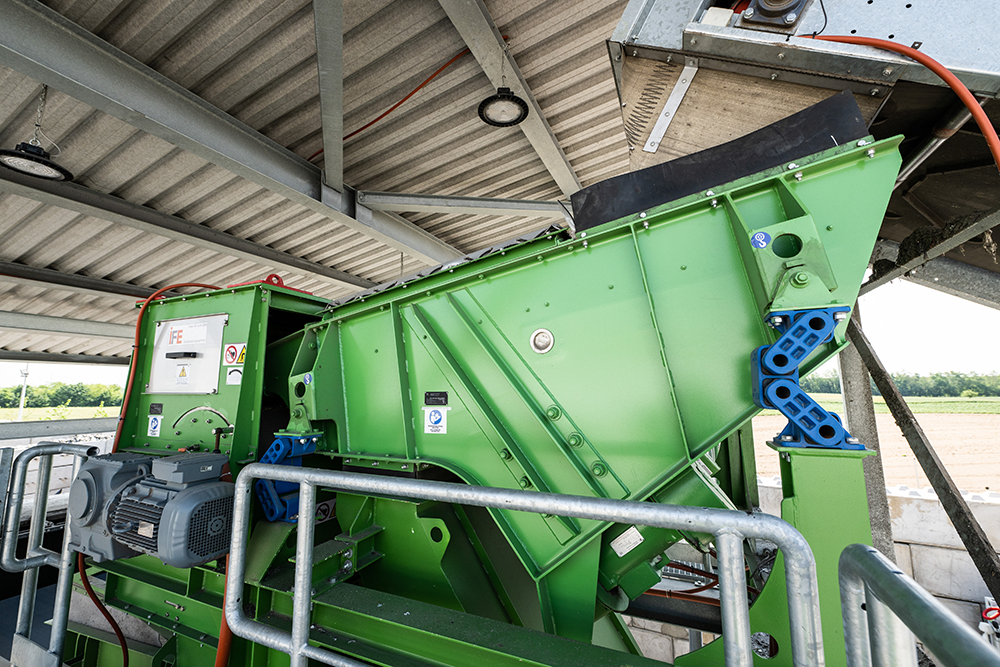


Which drives are used, and how durable and low-maintenance are they?
Depending on the application, IFE vibrating conveyors are equipped with an unbalanced motor, an unbalanced exciter, or an electromagnetic drive. The drives are designed for robust continuous operation, require no high-wear belts or gearboxes, and are characterized by long service life and low maintenance requirements. Regular visual inspections and simple replacement of wear parts are generally sufficient to ensure high availability over many years of operation.
What should be considered regarding wear lining for vibratory feeders?
For abrasive or highly wear-inducing materials, the conveyor trough is fitted with a wear lining, e.g. made of wear-resistant steel, rubber, or ceramic — matched to the material type, grain size, and conveying rate. A suitably chosen lining significantly reduces trough wear, extends the service life of the system, and thus lowers life-cycle costs. Linings are also typically modular in design and can be easily replaced when needed.